
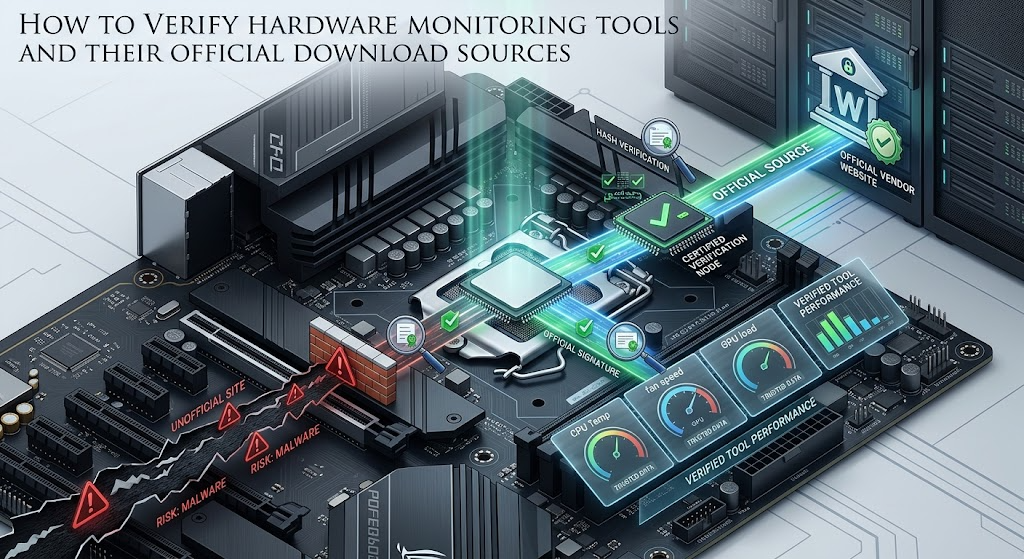
Hardware monitoring tools can provide useful information about CPU temperature, GPU temperature, fan speed, voltage, power consumption, clock speed, storage health, memory use, and other system conditions.
Because these utilities often interact directly with hardware sensors and low-level system interfaces, choosing the correct software and download source matters more than it might for an ordinary desktop application.
A professional-looking download page is not enough. Users should verify who publishes the utility, whether the file is current, what permissions it requires, and whether the readings it produces make sense for the hardware being monitored.
Start With the Original Developer
The safest starting point is normally the official project or developer page.
Third-party software directories may provide legitimate copies, but they can also host old versions, modified packages, wrappers, or files whose origin is unclear.
Identify the original publisher before downloading.
Check the Exact Tool Name
Popular monitoring utilities can attract lookalike pages and similarly named software.
Confirm the exact program name, developer, project page, and version before assuming a search result belongs to the tool you intended to install.
Watch for Lookalike Domains
A domain with one changed letter can appear convincing at a glance.
This deserves particular attention when the download is an executable file that will later request elevated privileges.
Keep General Web Navigation Separate From Software Verification
Hardware research may involve developer websites, motherboard support pages, processor documentation, GPU utilities, technical forums, repositories, and general web resources.
For broader online navigation, users can keep a general resource such as 주소모음 separately, while hardware-monitoring downloads, release notes, sensor documentation, driver information, and system-specific records remain organized around the computer being evaluated.
This makes it easier to distinguish ordinary browsing from software that will actually interact with system hardware.
Check Whether the Project Is Still Maintained
Monitoring utilities can remain downloadable years after active development stops.
Look for recent releases, documentation updates, repository activity, or support discussions.
Older software may still function, but newer hardware can require updated sensor support.
Compare the Current Version Number
Search engines sometimes surface older download pages.
Compare the listed version with the current release information from the developer before installing.
Read the Release Notes
Release notes can reveal support for new CPUs, GPUs, chipsets, motherboards, controllers, and sensors.
They may also describe fixed detection errors or incorrect readings from previous versions.
Check Windows Compatibility
A utility written for an older Windows version may still open on a newer system without functioning correctly.
Check whether the developer currently supports the operating system being used.
Check 32-Bit, 64-Bit, and ARM Support
Some tools provide different builds for different architectures.
Running the correct build can improve compatibility and reduce unnecessary troubleshooting.
Check Whether Installation Is Required
Some hardware monitoring utilities offer both installer and portable versions.
A portable version can be convenient for temporary testing, while an installed version may provide startup integration or longer-term logging.
Portable Does Not Mean Risk-Free
A portable executable can still access sensors, drivers, and operating-system resources.
It deserves the same source and integrity checks as an installer.
Check File Size
An unexpectedly different file size can indicate a wrong package, incomplete download, or modified installer.
Compare with official release information where available.
Use Checksums When Provided
Developers may publish cryptographic hashes such as SHA-256.
Comparing the downloaded file against the official value can help confirm that it was not corrupted or altered.
Check Digital Signatures
Some Windows utilities are digitally signed by their publisher.
A valid signature provides additional evidence about the origin and integrity of the executable.
Investigate Unexpected Signature Problems
Not every legitimate open-source utility is signed, but an invalid signature or unexpected publisher mismatch deserves investigation.
Do not simply ignore a warning because the filename looks familiar.
Scan the File Before Running It
Security software provides another layer of checking.
No security product is perfect, but unexplained warnings should be investigated before a utility receives access to the system.
Be Careful With Download Wrappers
Some software directories place the real program inside their own downloader.
This can introduce additional software or advertising offers that are unrelated to the monitoring utility.
Prefer the developer’s direct package when available.
Watch for Bundled Software
Installers may offer browser extensions, security software, system optimizers, or other optional programs.
Read installation screens carefully rather than accepting every default choice automatically.
Understand Why Administrator Rights Are Requested
Some hardware monitoring tools require elevated privileges to access low-level sensors or system interfaces.
The request can be legitimate, but users should understand why the utility needs that access before approving it.
Do Not Grant Elevated Rights to an Unverified File
Administrator access significantly increases what software can change or inspect.
Source verification should happen before elevation, not afterward.
Check Whether a Kernel Driver Is Installed
Some monitoring tools install or load a driver to read hardware registers and sensors.
This is not automatically dangerous, but kernel-level components require a high level of trust in the publisher.
Review Driver Signing
Modern Windows versions use driver-signing requirements to help protect system integrity.
Unexpected prompts to disable security protections simply to run a monitoring utility should be treated cautiously.
Check What the Tool Actually Monitors
Not every monitoring utility reads every sensor.
Some focus on CPU and motherboard data, others on GPU information, storage devices, fan control, or system-wide logging.
Choose a tool based on the actual diagnostic question.
Know the Difference Between Monitoring and Control
A utility that only displays temperatures is different from one that can change voltages, fan curves, power limits, or clock speeds.
Control functions introduce additional risk and should be used deliberately.
Do Not Change Settings Just Because the Tool Allows It
Monitoring data can be useful without modifying the system.
If the goal is diagnosis, begin by observing values rather than immediately adjusting power, voltage, or fan parameters.
Understand Sensor Names
Hardware can expose many temperature and voltage sensors with abbreviated or generic labels.
A reading called “Temp 2” or “Aux” may not correspond to the component a user assumes.
Do Not Panic Over One Strange Sensor
Unused or incorrectly interpreted sensor channels can sometimes produce impossible values.
A reported temperature far outside realistic operating conditions may indicate a misidentified sensor rather than an actual hardware problem.
Compare Critical Readings With Another Tool
When a temperature or voltage looks unusual, compare it with another reputable monitoring utility or manufacturer application.
Agreement across independent tools provides greater confidence.
Use Firmware Readings as Additional Context
BIOS or UEFI hardware-monitoring screens can provide another reference for motherboard, CPU, and fan values.
They will not always match Windows readings exactly because system load and measurement methods differ.
Expect Temperatures to Change Quickly
Modern processors can change frequency and power consumption extremely quickly.
Short temperature spikes are not necessarily equivalent to sustained overheating.
Look at Sustained Values
For cooling evaluation, readings over several minutes of a consistent workload can be more useful than a single peak value.
Logging features can help reveal whether high temperatures are temporary or persistent.
Check Idle and Load Separately
A system can appear cool at idle while reaching much higher temperatures during gaming, rendering, compiling, or stress testing.
Compare temperatures under conditions relevant to normal use.
Understand CPU Package Temperature
Processors may expose several core temperatures plus package or hotspot-style readings.
Different monitoring applications can present these sensors differently.
Use consistent sensor names when comparing results.
Understand GPU Hotspot Readings
Modern GPUs may report a general GPU temperature and a higher hotspot or junction temperature.
These values measure different parts of the device and should not be expected to match.
Check Manufacturer Specifications
When deciding whether a temperature is acceptable, manufacturer documentation and hardware-specific information are more useful than arbitrary universal thresholds.
Different processors and GPUs can have different normal operating ranges.
Do Not Compare Different Hardware Directly
Two CPUs with similar performance can have different thermal behavior because of architecture, packaging, cooling design, and power limits.
The same applies to graphics cards.
Check Fan Speed Units
Fan speeds are often reported in revolutions per minute.
A fan reading of zero can indicate a stopped fan, an unsupported sensor, or intentional zero-RPM operation depending on the hardware.
Understand Zero-RPM GPU Fans
Many graphics cards stop their fans at low temperature.
A zero reading at idle can therefore be normal.
The fans should respond appropriately when GPU temperature increases.
Check Fan Curves Before Changing Them
Aggressive fan curves can reduce temperature while increasing noise and fan wear.
A quieter curve can increase operating temperature.
Any change involves tradeoffs.
Verify Voltage Readings Carefully
Incorrectly identified voltage sensors can produce misleading values.
Do not make hardware decisions based on one suspicious voltage reading without confirming it through another reliable source.
Be Careful With Software Voltage Adjustments
Changing processor or GPU voltage can affect stability, temperature, and hardware longevity.
Monitoring software should not automatically become an overclocking tool simply because adjustment options are present.
Understand Power Readings
CPU package power and GPU board power can be estimated or measured differently depending on the hardware and utility.
Small differences between monitoring programs are not necessarily errors.
Check Clock Speeds Under Load
Modern CPUs and GPUs dynamically adjust frequency according to workload, temperature, voltage, and power limits.
A lower idle frequency is usually normal and can indicate power-saving behavior.
Do Not Judge Performance From Maximum Clock Alone
A processor may briefly reach a high boost clock without sustaining it across every core.
Effective clock readings and workload behavior can provide additional context.
Check Storage Health Separately
Some monitoring utilities display SMART information for hard drives and SSDs.
Storage-health interpretation can be more complex than simply looking for a green status indicator.
Review SMART Attributes Carefully
Different manufacturers use SMART attributes differently.
Raw values should be interpreted using drive-specific documentation where possible.
Do Not Use Monitoring Software as the Only Backup Strategy
A drive can fail even after reporting normal health.
Monitoring can provide warning signs, but important data still requires proper backups.
Check NVMe Temperature
Fast NVMe SSDs can become warm during sustained workloads.
Monitoring temperature can help identify airflow or thermal-throttling issues when storage performance changes unexpectedly.
Use Logging for Intermittent Problems
Some crashes or performance drops occur only occasionally.
Logging temperatures, clocks, power, and fan speed over time can help identify what happened immediately before the issue.
Choose a Reasonable Logging Interval
Extremely frequent logging can produce huge files without adding useful information for ordinary troubleshooting.
Choose an interval appropriate to the problem being investigated.
Check Time Stamps
Accurate timestamps make logs much more useful when matching hardware behavior with game crashes, application errors, or system events.
Monitor One Change at a Time
If users simultaneously change fan curves, power limits, memory settings, and drivers, it becomes difficult to determine what caused an improvement or new problem.
Change one variable and observe the result.
Check Background CPU Usage
Unexpectedly high idle temperature can result from a process keeping the processor busy.
Monitoring CPU load alongside temperature helps distinguish cooling problems from background activity.
Check GPU Usage Too
High GPU temperature at the desktop can indicate that an application, browser, game launcher, or background process is using hardware acceleration.
Temperature should be interpreted alongside load.
Watch for Sensor Polling Conflicts
Running several low-level monitoring utilities simultaneously can occasionally create conflicts or inconsistent readings on certain systems.
If values become unstable, test one monitoring program at a time.
Do Not Run Every Monitoring Utility at Startup
Installing several tools and launching all of them automatically creates unnecessary background processes.
Keep only the utilities that provide information actually needed.
Check Resource Usage
A monitoring program should not consume large amounts of CPU or memory merely to display sensor values.
Unexpected resource usage can indicate a software problem or overly aggressive polling settings.
Check Update Behavior
Some utilities update automatically, while others require manual downloads.
Understand how updates are delivered so that future versions still come from a trusted source.
Be Careful With In-App Update Links
A legitimate application’s update feature can be convenient, but users should still verify unexpected prompts or unusual download locations.
Review Privacy and Telemetry
A basic hardware monitor may need access to system configuration but does not necessarily need unrelated personal information.
Review what data the application collects or transmits where documentation is available.
Check Network Activity if It Seems Unnecessary
Some utilities use internet access for update checks or remote monitoring features.
Unexpected continuous network activity deserves explanation.
Understand Remote Monitoring Features
Some advanced tools can expose sensor information through a web interface or remote service.
If those features are not needed, leaving them disabled can reduce unnecessary exposure.
Do Not Expose Monitoring Interfaces Publicly Without Understanding Them
Remote dashboards can reveal hardware and system information.
Access controls and network configuration should be considered before making them reachable outside a trusted network.
Check Open-Source Project Repositories Carefully
Open-source utilities may publish code and releases through repositories.
Download the official project release rather than an unrelated fork unless there is a specific reason to use the fork.
Check Repository Ownership
Search results can lead to cloned or abandoned repositories.
Verify the project owner and release history before downloading compiled files.
Use Community Reports as Supporting Evidence
Forums can help identify sensor-label issues, motherboard compatibility, and unusual readings.
They should supplement rather than replace official documentation and direct testing.
Check Discussion Dates
Hardware support can change rapidly.
Advice written for an older processor generation or software version may not apply to current systems.
Search by Exact Hardware Model
When troubleshooting a reading, include the exact motherboard, laptop, CPU, GPU, or sensor-controller model.
Generic searches often produce advice for completely different hardware.
Be Careful With Laptop Sensors
Laptop thermal designs are highly model-specific.
Temperature and fan behavior that look unusual compared with a desktop system may be normal for a particular notebook design.
Check OEM Utilities
Laptop and motherboard manufacturers sometimes provide their own monitoring or control software.
These tools can provide useful comparison points for fan behavior, power modes, and device-specific sensors.
Do Not Install Multiple Control Utilities Without a Reason
Two programs attempting to control the same fan or power setting can create unpredictable behavior.
Choose one control method whenever possible.
Uninstall Abandoned Test Utilities
Troubleshooting often results in several temporary programs being installed.
Remove utilities that are no longer needed once the comparison is complete.
Keep a Record of Normal Values
One of the most useful monitoring practices is establishing a baseline when the computer is working normally.
Record typical idle and load temperatures, fan speeds, clocks, and power values.
Compare Against Your Own Baseline
A sudden temperature increase on the same computer can be more informative than comparing the system with a completely different build.
Dust, fan failure, thermal-interface changes, or software behavior can then be investigated.
Use a Simple Verification Checklist
Before downloading or trusting a hardware monitoring tool, check:
- original developer and official download location
- current version and release history
- Windows and hardware compatibility
- digital signature or checksum where available
- administrator or driver requirements
- whether the utility monitors or also changes settings
- sensor names and manufacturer specifications
- readings against another reputable tool
- logging, privacy, and remote-access settings
- whether the software is still actively maintained
Good Monitoring Starts With Trustworthy Software
Hardware monitoring is useful only when users can trust both the program and the way its readings are interpreted.
Downloading from the original source, checking compatibility, understanding permissions, and comparing unusual sensor values with another reliable reference can prevent many false alarms and unnecessary system changes.
The goal is not to collect as many numbers as possible. It is to use dependable tools to understand how the hardware normally behaves and recognize when something genuinely changes.